
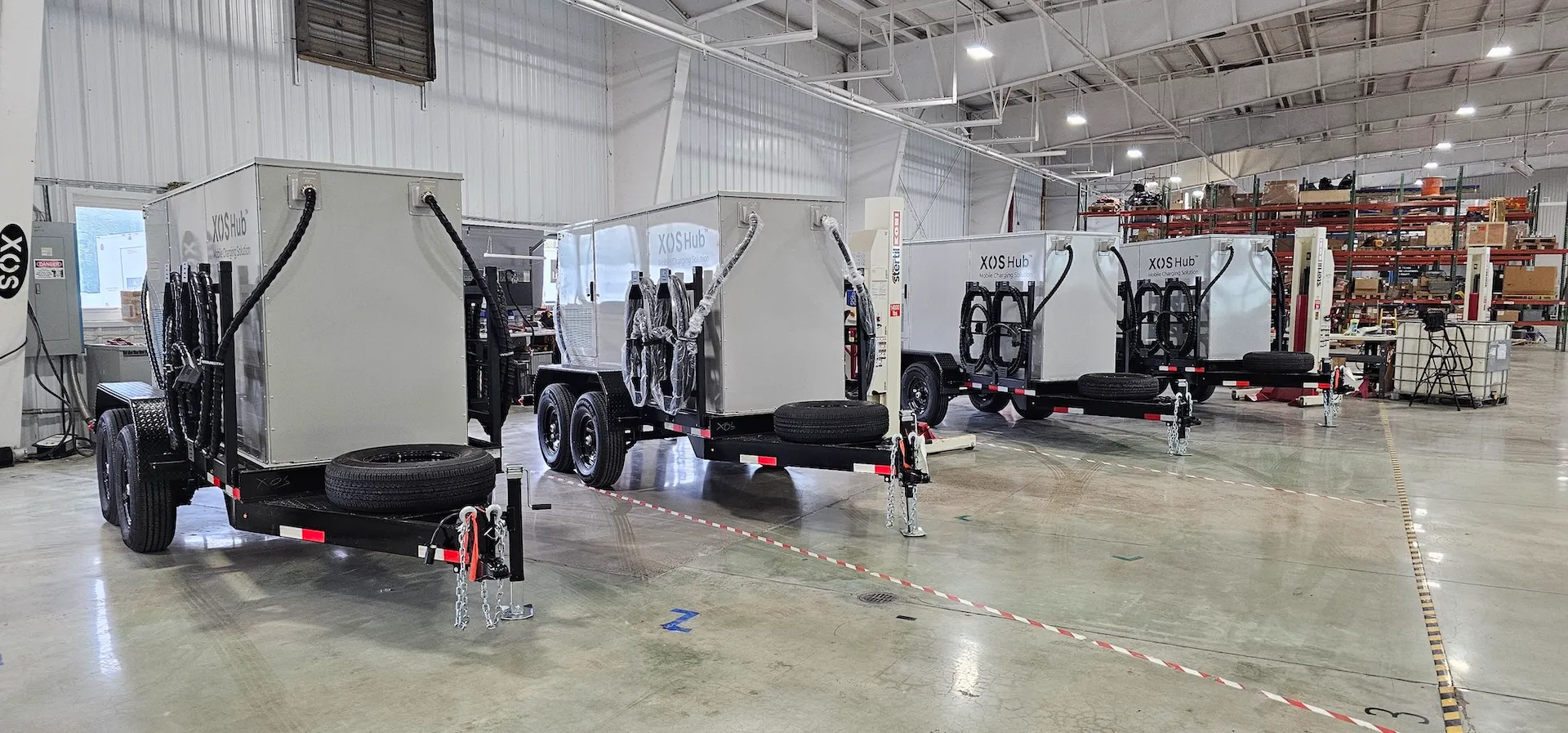

Xos, Inc. has been awarded a prototype Other Transaction Agreement by the U.S. Air Force to develop a deployable mobile charging system, with a period of performance extending into late 2027. The award came through the Air Force Global Strike Command Rapid Capabilities Division 2026 Showcase and marks the first Air Force contract for the Los Angeles-based electric truck and charging company. Under the agreement, Xos will adapt its Xos Hub mobile battery energy storage system to charge electrified support equipment and vehicles in field conditions.
Highlights
- Prototype Other Transaction Agreement awarded through the AFGSC Rapid Capabilities Division 2026 Showcase — Xos’s first U.S. Air Force contract
- Period of performance extends into late 2027
- Primary assembly and integration at Xos’s Byrdstown, Tennessee facility; the system is designed in California
- Market research cited by Xos projects the global military power solutions sector at $19.87 billion by 2033, growing 7.7% annually
What the Prototype Agreement Covers
The award was made under the AFGSC Rapid Capabilities Division Showcase, which the company describes as a competitive, merit-based program that evaluates and fields emerging commercial technologies. Xos says the agreement establishes it as a defense technology provider and opens a new addressable market for its mobile energy platform.
The company frames the award as validation that the Hub can meet Department of Defense mission requirements — a claim that rests on the prototype phase rather than on completed fielding.
How the Hub Changes for Military Use
Under the prototype agreement, Xos will modify the Hub to deliver standards-based charging for electrified support equipment and vehicles, extending the grid-independent operation used by commercial fleets into field environments, according to the company. The release characterizes the resulting unit as a ruggedized version of the existing platform but does not specify capacity, output, or environmental qualification standards for the military configuration.
“This award marks a strategic inflection point for Xos. When the United States Air Force evaluates the market and selects our technology, it confirms what we set out to build from day one: a mobile energy platform proven in commercial operations that can meet the most demanding mission requirements in the field. Defense is a significant new addressable market for the Xos Ecosystem, and it is one where our advantages compound: American design and manufacturing, proven reliability, and deployable power that needs no fixed infrastructure. This is how Xos scales, carrying a platform already trusted across multiple sectors into the highest-stakes markets in the world,” said Dakota Semler, Chief Executive Officer of Xos.
Where the System Will Be Built
The system is designed in California and manufactured in Tennessee, with primary assembly and integration at the company’s Byrdstown, Tennessee facility. Xos describes the arrangement as a domestic design-to-build model.
“This award reflects disciplined execution across engineering, operations, and manufacturing. As a non-traditional contractor, we move fast and we deliver, adapting a commercially proven product for a new mission and building it right here in Tennessee. It is a powerful demonstration of the flexibility of our platform and the strength of our American manufacturing base,” said Giordano Sordoni, Co-Founder and Chief Operating Officer of Xos.
What Defense Market Is Xos Targeting?
Market research cited by the company projects the global military power solutions sector to reach $19.87 billion by 2033, growing at 7.7% annually as armed forces prioritize portable, high-efficiency energy.
Xos points to two demand signals behind that projection. The Department of Defense is the largest institutional consumer of energy in the United States, and the U.S. Army has committed to fielding microgrids at every installation and an all-electric non-tactical vehicle fleet by 2035. The company positions the Hub as a way to supply high-capacity power at those sites without permanent infrastructure.
What Comes Next
Xos says the agreement lets it demonstrate the Hub across new operating environments while deepening domestic manufacturing capability, and that it intends to pursue additional opportunities in mobile charging and energy storage. The company has previously extended the Hub platform beyond fleet charging, including a data-center-oriented Power Hub built on the same battery and controls architecture, and an expanded Hub lineup spanning three capacity tiers.