
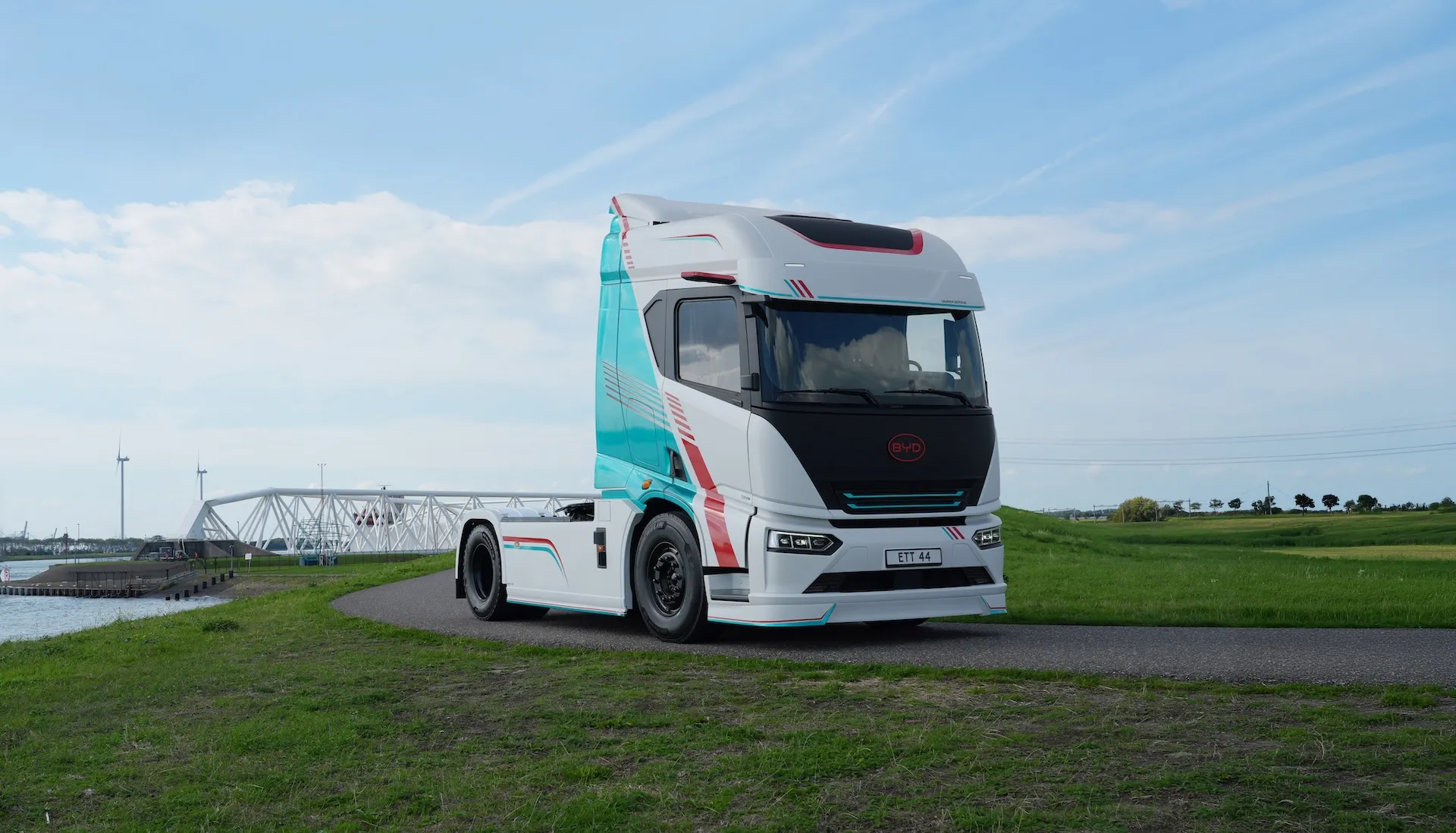
BYD Commercial Vehicles has unveiled the ETT 44, a heavy-duty electric tractor with up to 986 hp (1,000 PS), a 651 kWh Blade Battery and a claimed range of up to 372 miles, at IAA Transportation 2026 in Hannover, Germany. The company says the truck charges from 20% to 80% in about 20 minutes on a 1.5 MW megawatt charging connection, adding up to 248 miles of range. The flagship anchors an expanded European lineup from BYD that now spans 3.5 to 44 metric tons (7,716 to 97,003 lb), including new Rigid 4×2 and 6×2 models shown in 26-metric-ton (57,320 lb) Swap Body and Hooklift versions.
Highlights
- ETT 44 flagship tractor: 651 kWh Blade Battery (LFP), 851.2 V nominal system voltage, 733 hp (743 PS) rated and up to 986 hp (1,000 PS) peak drive power
- Megawatt charging: 1.5 MW+ MCS charging takes the battery from 20% to 80% in 20 minutes or less; CCS2 charging at 420 kW takes 60 minutes or less
- Battery warranty: 10 years or 745,645 miles (1.2 million km) as standard, which BYD says exceeds typical European market coverage
- Portfolio expansion: New rigid trucks, vocational models and yard tractors extend BYD’s European commercial range from 3.5 to 44 metric tons
How Does BYD’s Commercial Vehicle Ecosystem Work?
BYD describes the portfolio as a vertically integrated package combining proprietary vehicle technology, Blade Battery cells, megawatt charging, energy storage systems, energy management software and financial services. The company positions itself as a single-partner supplier for fleets transitioning to zero-emission transport, covering urban distribution, municipal applications, and regional and long-haul logistics.
Central to the offering is what BYD calls its Total Cost of Mobility (TCM) approach, which the company says manages vehicle efficiency, charging performance, energy procurement, infrastructure utilization and lifecycle management as a single optimized system. According to BYD, the goal is to reduce operational complexity, improve uptime and shorten the path to profitable electrification.
Stella Li, Executive Vice President of BYD, tied the truck launch to the company’s existing passenger-car charging technology, which The EV Report covered when BYD introduced Blade Battery 2.0 and 1,500 kW FLASH Charging earlier this year.
“We have already put FLASH Charging into practice in passenger vehicles. Today, we are bringing this technology to commercial vehicles, starting with our trucks. With 1.5 Megawatts of charging power, it can charge from 20% to 80% in about 20 minutes — delivering up to 248 miles of range. Less time charging. More time on the road,” Li said.
“Greater efficiency for every vehicle. From batteries and solar power to energy storage, FLASH Charging and commercial vehicles. We provide a one-stop Solution for Sustainable commercial transport. One company. One ecosystem. One total energy solution.”
ETT 44 Design and Warranty
BYD describes the ETT 44 as a native electric platform developed from the ground up, combining high drive power, megawatt charging capability, Blade Battery technology and driver-focused ergonomics in a purpose-built architecture. The company also frames the truck as a new design direction for its commercial vehicles, with styling intended to establish immediate brand recognition in the European market.
The Blade Battery carries a 10-year, 745,645-mile (1.2-million-km) warranty as standard. BYD states that this exceeds the two- to three-year base-vehicle warranties and six- to eight-year battery warranties it says are typical across the European market, where extended coverage is usually a paid option.
The ETT 44 launches alongside rigid trucks, vocational models and yard tractors that share the same technology foundations. BYD’s move into megawatt charging follows other European truck makers, including Scania’s commercial rollout of its Megawatt Charging System earlier this year.
ETT 44 4×2 Specifications
| Section | Specification | Value |
|---|---|---|
| Vehicle | Vehicle type | Battery-electric heavy-duty tractor |
| Vehicle | Drive configuration | 4×2 |
| Vehicle | Cab | High-roof, flat-floor sleeper cab |
| Dimensions & Weights | Overall dimensions (L × W × H) | 252 × 99.6 × 150.4 in (6,400 × 2,530 × 3,820 mm) |
| Dimensions & Weights | Wheelbase | 149.6 in (3,800 mm) |
| Dimensions & Weights | Gross vehicle weight (GVW) | 44,092 lb (20,000 kg) |
| Dimensions & Weights | Gross combination weight (GCW) | 97,003 lb (44,000 kg) |
| Dimensions & Weights | Curb weight | 24,141–24,559 lb (10,950–11,140 kg) |
| Dimensions & Weights | Front / rear axle design load | 18,739 / 27,558 lb (8,500 / 12,500 kg) |
| Battery & Powertrain | Battery capacity | 651 kWh |
| Battery & Powertrain | Cell chemistry | Blade Battery (LFP) |
| Battery & Powertrain | Nominal vehicle voltage | 851.2 V |
| Battery & Powertrain | Rated drive power | 733 hp (743 PS) |
| Battery & Powertrain | Peak drive power | Up to 986 hp (1,000 PS) system peak |
| Charging | CCS2 DC charging power | 420 kW |
| Charging | CCS2 charging time (20–80% SOC) | ≤60 min |
| Charging | MCS charging power | 1.5 MW+ |
| Charging | MCS charging time (20–80% SOC) | ≤20 min |
| Performance | Driving range | To be confirmed |
| Performance | Top speed | 56 mph |
| Performance | Maximum gradeability | 25% |
| Performance | Minimum turning radius | 24.0 ft (7.3 m) |
| Chassis | Suspension | Front and rear air suspension with ECAS control |
| Chassis | Wheels | Aluminum |
| Chassis | Tires | Front 385/55 R22.5; Rear 315/70 R22.5 |
| Chassis | Fifth wheel | 2-inch (50 mm) fixed fifth wheel |
| Safety & ADAS | Full ADAS suite | ACC, PCC, TSR, ISA, FCW, AEBS, LKA, AFL, LDW, LDP, LCW, DOW, MOIS, BSIS |
| Safety & ADAS | Safety devices | EBS, ESC, HHC, direct TPMS, and axle load display |
| Cab & Connectivity | Digital cockpit | 12.8-inch central display, Apple CarPlay, Android Auto, and Fleetlink |