
GM says electric vehicle owners can charge at home in two ways — Level 1 through a standard 120-volt outlet, or Level 2 through a professionally installed 240-volt circuit that can add up to 44 miles of range per hour. More than 80% of EV charging in the U.S. happens at home rather than at public stations, according to the International Energy Agency. GM cites AAA data showing the average American drives about 30 miles a day, meaning many owners only need to plug in a few times a week. The company’s guidance also covers the NACS and CCS1 plug standards and the vehicle-to-home power features available on its bidirectional-capable EVs.
Highlights
- More than 80% of U.S. EV charging happens at home, according to the International Energy Agency.
- Level 1 charging (120 volts) adds 3 to 5 miles of range per hour; GM’s Level 2 chargers (240 volts) can add up to 44 miles per hour, the company says.
- A full charge of the Chevrolet Equinox EV costs about $152 at the U.S. average electricity rate of under 18 cents per kWh, according to GM.
- GM’s V2H-capable EVs, including the Chevrolet Silverado EV Work Truck Max Range, can power a properly equipped home for up to five days during an outage, the company says.
Level 1 vs. Level 2 Charging
Level 1 charging requires no special installation — the charger plugs directly into any standard household outlet. The tradeoff is speed: Level 1 typically adds 3 to 5 miles of range per hour, which GM says suits drivers who travel short distances or plug in nightly. Level 2 charging runs on the same type of 240-volt circuit used by a clothes dryer and requires a professional electrician to install. In exchange, GM’s Level 2 home chargers can add up to 44 miles of range per hour. A third tier, Level 3 (DC fast charging), exists only at public stations and isn’t available for home use.
| Level 1 | Level 2 | |
|---|---|---|
| Voltage | 120 volts | 240 volts |
| Installation | Plugs into a standard outlet | Requires a licensed electrician |
| Range added | 3–5 miles per hour | Up to 44 miles per hour* |
*Based on GM’s own figures; the company notes actual charging rates vary with battery condition, charger output, vehicle settings, and outside temperature.
For day-to-day driving, GM recommends charging to 80% to support long-term battery health, reserving a full charge for longer trips.
NACS vs. CCS1: Which Plug Do You Need?
GM electric vehicles use one of two charge-port standards. NACS (North American Charging Standard) appears on newer GM EVs, and the company expects all new 2027 model year EVs across Chevrolet, GMC, and Cadillac to launch with native NACS ports between now and December 2026. CCS1 — technically J1772 Combo — was the original standard used on GM EVs and remains on past model years. The two plug types function identically; only the physical shape of the connector differs, similar to the difference between USB-C and older phone-charging ports. Owners with a mismatched charger and vehicle port aren’t stuck: GM offers adapters that convert between NACS and J1772, letting a NACS-equipped EV charge on a J1772 charger or vice versa.
Installing a Home Charger
A Level 1 charger needs no installation beyond plugging it in. Level 2 installation cost depends on several factors GM outlines: the distance from the charger to the home’s main electrical panel, the age and condition of the home’s wiring, and whether the panel has enough spare capacity. GM says only a licensed electrician should handle a Level 2 installation, and owners should consult their vehicle’s mobile app for setup guidance once the hardware is in place. Many newer homes with 200-amp panel service are well-suited for a Level 2 charger; older homes may need panel upgrades or supplemental equipment, which is why GM recommends consulting an electrician before committing to an installation.
Smart Charging and Backup Power
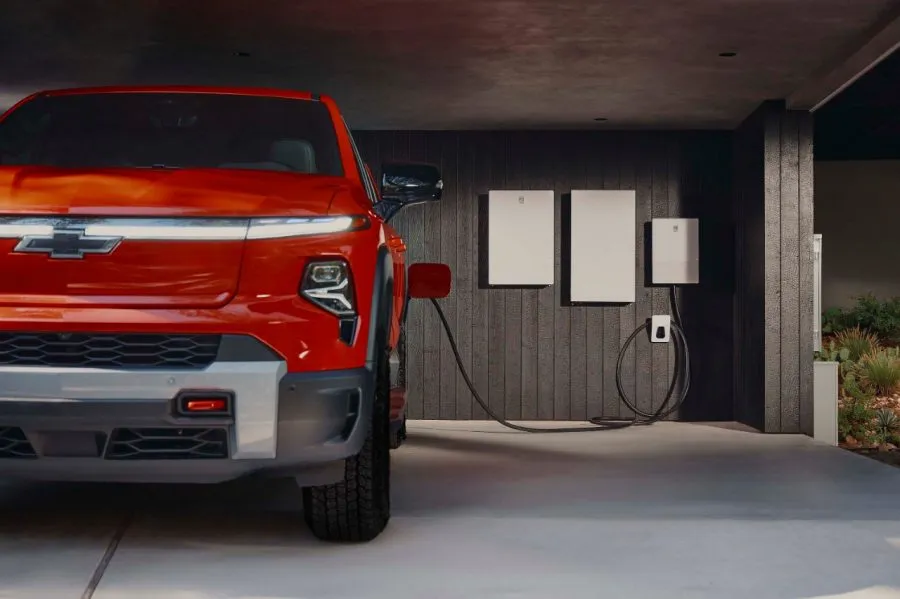
Beyond convenience, GM is positioning home charging as a source of backup power for bidirectional-capable EVs. Paired with the GM Energy V2H Enablement Kit and a PowerShift Charger, a compatible GM EV can supply power to a properly equipped home during an outage — a capability the company has detailed in its broader vehicle-to-home and vehicle-to-grid rollout. Citing U.S. Energy Information Administration data on average daily household energy use (about 30 kWh), GM says its 2026 Chevrolet Silverado EV Work Truck Max Range can power a home for up to five days in a blackout. The company also sells standalone GM Energy PowerBanks that pair with a Home Hub and Inverter to store solar surplus or grid power; GM says its largest PowerBank can deliver an estimated 20 hours of backup electricity.
Common Questions
Do you need to upgrade your electrical panel? It depends on the home. Older houses may lack sufficient capacity at the main panel, while many newer homes with 200-amp service are already equipped for Level 2 charging. GM points to a growing set of solutions that avoid a full panel upgrade, and recommends an electrician evaluate the specific setup.
Can you charge an EV on a regular household outlet? Yes — that’s Level 1 charging. It requires no special equipment but is considerably slower than Level 2.
GM’s guidance also covers a few adjacent points: hardwired and plug-in Level 2 chargers function nearly identically, differing mainly in how they connect to household wiring; permit requirements for a home charger installation vary by location and are best handled by a local electrician; and a properly installed home charger requires no special ventilation, since there are no fumes involved.
Sign up for our popular weekly email to catch all the latest EV news!